


| SNo. | Scientific Name | Locality | Habitat | Basis of Record | Description | Recorded By | Record Number | Island | Source | Date |
|---|---|---|---|---|---|---|---|---|---|---|
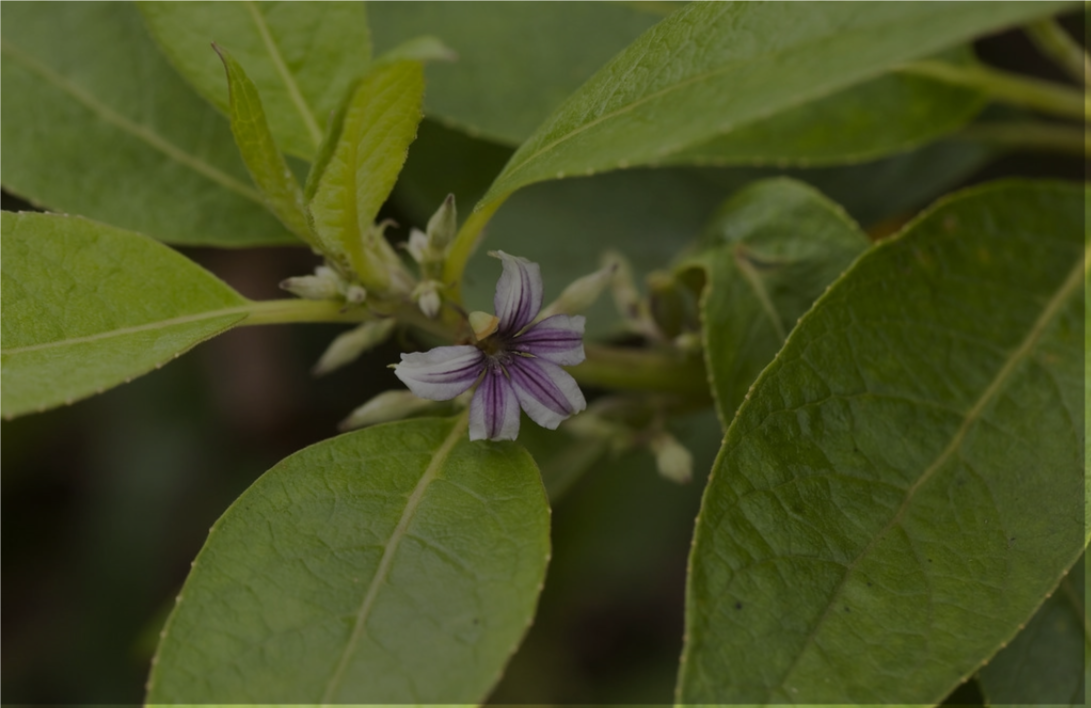
| 1 | Geniostoma tinifolium var. wahiawaense | Locality redacted. Contact Bishop Museum Botany Department for details | In deep shade, left side of stream, in same area as earlier Nothocestrum collection. Clay soil. Slope 40 degrees. | Preserved_Specimen | 12 ft. tree | Perlman, S. | 500 | Kauai | BISH | 1980-04-29 |
| 2 | Geniostoma tinifolium var. wahiawaense | Locality redacted. Contact Bishop Museum Botany Department for details | Dense wet forest with moderate to heavy Psidium growth, except upper part of valley dominated by Metrosideros with understory of Psychotria, Hedyotis terminalis, 3 spp. Cyanea, Dicranopteris (in open areas), 3 spp. Cyrtandra & Labordia hirtella. | Preserved_Specimen | Tree 3.5 m tall; corolla green | Wagner, W.L. | 6050 | Kauai | BISH | 1988-04-10 |
| 3 | Geniostoma tinifolium var. wahiawaense | Locality redacted. Contact Bishop Museum Botany Department for details | In deep shade, left side of stream, in same area as earlier Nothocestrum collection. Clay soil. Slope 40 degrees. | Preserved_Specimen | 12 ft. tree | Perlman, S. | 500 | Kauai | BISH | 1980-04-29 |
| 4 | Geniostoma tinifolium var. wahiawaense | Locality redacted. Contact Bishop Museum Botany Department for details | In Metrosideros-Cheirodendron spp. lowland wet forest with Broussaisia, Melicope, Hedyotis, Freycinetia, Pritchardia, Antidesma, Psychotria, Elaphoglossum, Viola helenae, Cyrtandra, Hesperomannia, Dicranopteris. | Preserved_Specimen | Several scattered plants with flowers & fruit. | Perlman, S. | 5976 | Kauai | BISH | 1987-06-20 |
| 5 | Geniostoma tinifolium var. wahiawaense | Locality redacted. Contact Bishop Museum Botany Department for details | Closed Metrowideros forest, 8-12 m canopy. Understory dominated by Antidesma w/mixed wet associates, Syzygium, Broussaisia, Perrottetia, Cyrtandra spp, Psychotria spp, Dubautia spp, Labordia spp, Coprosma waimeae, Cheirodendron spp, Tetraplasandra | Preserved_Specimen | Tree 4 m tall, few branched, trunk brown, 7 cm diameter @ base, lvs dark green above, white-green below, 4 trees observed. | Wood, K.R. | 13269 | Kauai | BISH | 2008-09-11 |
| 6 | Geniostoma tinifolium var. wahiawaense | Locality redacted. Contact Bishop Museum Botany Department for details | Wet forest dominated by Metrosideros, Antidesma, Cyrtandra spp. & Athyrium. | Preserved_Specimen | Treelet of 10 ft. Leaves dark, dull green above, paler below. Corolla light green to whitish-green. | Flynn, T.W. | 2982 | Kauai | BISH | 1988-05-22 |
| 7 | Geniostoma tinifolium var. wahiawaense | Locality redacted. Contact Bishop Museum Botany Department for details | Low wet forest dominated by Metrosideros polymorpha, M. waialealae, Syzygium, Antidesma, Tetraplasandra & Cheirodendron with understory rich in shrubs & ferns. | Preserved_Specimen | Small, slender tree 2 m tall. flowers & fruit. Leaves dark, glossy green above, slightly discolorous. Sterile. Localized population, endemic. | Lorence, D.H. | 6648 | Kauai | BISH | 1990-12-11 |
| 8 | Geniostoma tinifolium var. wahiawaense | Locality redacted. Contact Bishop Museum Botany Department for details | Preserved_Specimen | One small tree. | Perlman, S. | 484 | Kauai | BISH | 1979-08-13 | |
| 9 | Geniostoma tinifolium var. wahiawaense | Preserved_Specimen | Perlman, S. | 500 | Kauai | BISH | 1980-04-29 |
Lorem ipsum dolor sit amet, consectetur adipiscing elit, sed do eiusmod tempor incididunt ut labore et dolore magna aliqua. Ut enim ad minim veniam, quis nostrud exercitation ullamco laboris nisi ut aliquip ex ea commodo consequat. Duis aute irure dolor in reprehenderit in voluptate velit esse cillum dolore eu fugiat nulla pariatur. Excepteur sint occaecat cupidatat non proident, sunt in culpa qui officia deserunt mollit anim id est laborum.
Lorem ipsum dolor sit amet, consectetur adipiscing elit, sed do eiusmod tempor incididunt ut labore et dolore magna aliqua. Ut enim ad minim veniam, quis nostrud exercitation ullamco laboris nisi ut aliquip ex ea commodo consequat. Duis aute irure dolor in reprehenderit in voluptate velit esse cillum dolore eu fugiat nulla pariatur. Excepteur sint occaecat cupidatat non proident, sunt in culpa qui officia deserunt mollit anim id est laborum.
Lorem ipsum dolor sit amet, consectetur adipiscing elit, sed do eiusmod tempor incididunt ut labore et dolore magna aliqua. Ut enim ad minim veniam, quis nostrud exercitation ullamco laboris nisi ut aliquip ex ea commodo consequat. Duis aute irure dolor in reprehenderit in voluptate velit esse cillum dolore eu fugiat nulla pariatur. Excepteur sint occaecat cupidatat non proident, sunt in culpa qui officia deserunt mollit anim id est laborum.
Lorem ipsum dolor sit amet, consectetur adipiscing elit, sed do eiusmod tempor incididunt ut labore et dolore magna aliqua. Ut enim ad minim veniam, quis nostrud exercitation ullamco laboris nisi ut aliquip ex ea commodo consequat. Duis aute irure dolor in reprehenderit in voluptate velit esse cillum dolore eu fugiat nulla pariatur. Excepteur sint occaecat cupidatat non proident, sunt in culpa qui officia deserunt mollit anim id est laborum.
Lorem ipsum dolor sit amet, consectetur adipiscing elit, sed do eiusmod tempor incididunt ut labore et dolore magna aliqua. Ut enim ad minim veniam, quis nostrud exercitation ullamco laboris nisi ut aliquip ex ea commodo consequat. Duis aute irure dolor in reprehenderit in voluptate velit esse cillum dolore eu fugiat nulla pariatur. Excepteur sint occaecat cupidatat non proident, sunt in culpa qui officia deserunt mollit anim id est laborum.
Lorem ipsum dolor sit amet, consectetur adipiscing elit, sed do eiusmod tempor incididunt ut labore et dolore magna aliqua. Ut enim ad minim veniam, quis nostrud exercitation ullamco laboris nisi ut aliquip ex ea commodo consequat. Duis aute irure dolor in reprehenderit in voluptate velit esse cillum dolore eu fugiat nulla pariatur. Excepteur sint occaecat cupidatat non proident, sunt in culpa qui officia deserunt mollit anim id est laborum.
Thank you for your interest in submitting an image of
Select your image and leave a brief description of your photo below.